
THE BENGUET PRECIPICE: Was Usec. Cabral’s Fatal Plunge a Tragic Accident or a Silent Execution?
The misty mountains of Benguet usually whisper of peace and serenity, but on the morning of December 19, 2025, they became the scene of a tragedy that has sent a chilling tremor through the highest corridors of the Philippine government. The sudden death of former Department of Public Works and Highways (DPWH) Undersecretary Ma. Catalina Cabral—once the most powerful woman in infrastructure—has left behind a trail of unanswered questions, missing documents, and a haunting legal battle that is only just beginning to surface in January 2026.
The headline currently paralyzing the political landscape is as sensational as a noir thriller: “THE SILENT WITNESS: Usec. Cabral’s Camp Claims She Was Never Subpoenaed Before Her Fatal Fall—What Was the Independent Commission Hiding?”
This is an investigative chronicle into the final days of a public servant, the “purported” invitation that never arrived, and the mysterious abyss that swallowed the woman who knew too much.
I. THE INCIDENT: The Fall That Shook the Nation
On December 19, the news broke like a thunderclap: Ma. Catalina Cabral, a 40-year veteran of the DPWH, had reportedly fallen into a deep ravine in Benguet. To the public, it was a freak accident during a mountain excursion. But to the legal investigators and the “Marites” of the political world, the timing was nothing short of suspicious.
Just four days prior, on December 15, the Independent Commission for Infrastructure (ICI) had held a high-stakes hearing. Cabral’s chair was empty. The optics were devastating—it looked like a high-ranking official was fleeing from the truth. But today, her counsel, Atty. Mae Divinagracia, has shattered that narrative.
II. THE LEGAL BOMBSHELL: “She Was Not Informed”
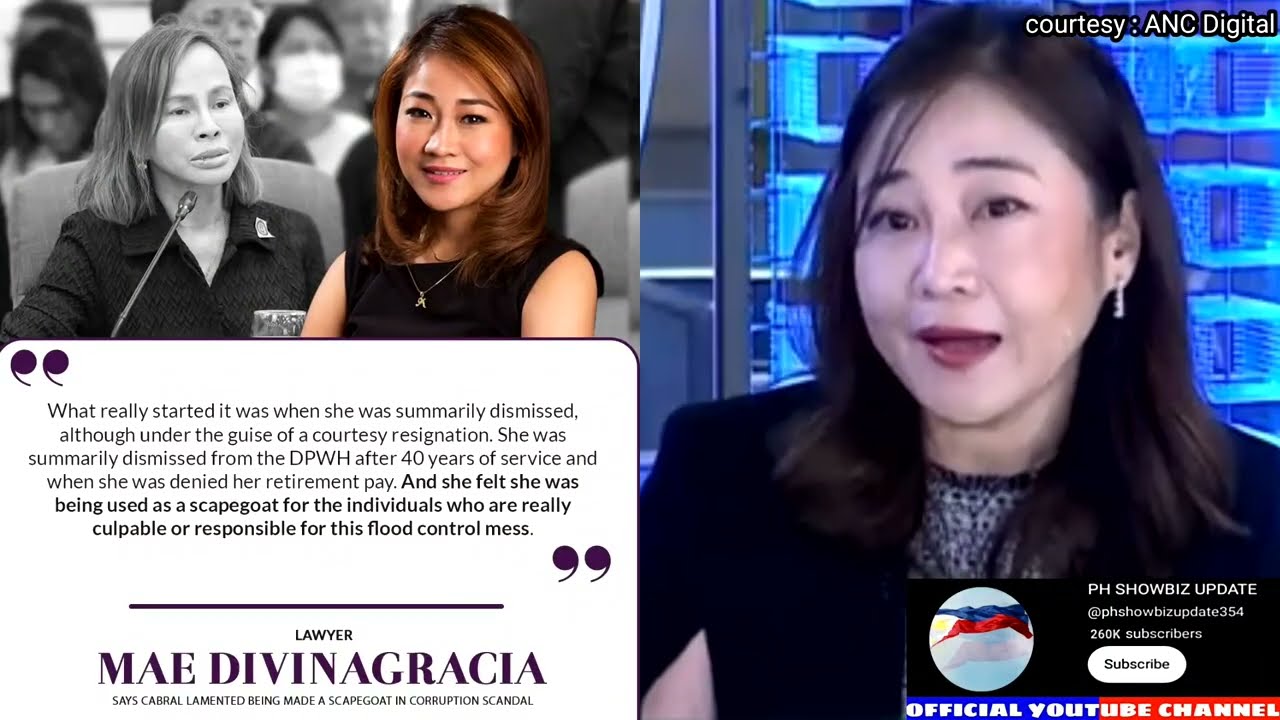
In an exclusive and heart-wrenching interview, Atty. Divinagracia revealed that the “flight” narrative was a lie. Cabral didn’t snub the hearing; she didn’t even know it was happening.
“Ms. Cabral was not informed of the hearing. She did not receive any communication, let alone the purported subpoena,” the lawyer stated.
The Mystery of the Missing Subpoena:
The Wrong Address: The subpoena was reportedly sent to the DPWH office after Cabral had already resigned. It was public knowledge she was no longer there, yet the “notice” was sent to a desk she no longer occupied.
The Intent: Far from hiding, Cabral was preparing to air her side. She had already spoken to the Ombudsman in private, ready to expose the “algorithmic formula” she created to stop political discretion in project allocations—a formula that was allegedly overridden by the House leadership.
III. THE INVESTIGATION: A Spiral Into the Abyss
While the family has ruled out “foul play” in the traditional sense, the investigation into her mental state reveals a woman crushed by the weight of being a scapegoat.
The Spiral of Depression: Atty. Divinagracia described a “spiraling” depression that began when Cabral was summarily dismissed under the guise of a courtesy resignation by Secretary Vince Dizon. After 40 years of service, she was denied her retirement pay and watched as men in power—like Secretary Manuel Bonoan and Undersecretary Roberto Bernardo—shifted the blame for the multi-billion peso “flood control mess” onto her shoulders.
The Previous Attempts: It was revealed for the first time on national television that the Benguet fall was not the first time Cabral tried to end the pain.
The Knife and the Stairs: Days after being implicated by Usec. Bernardo in a hearing, she tried to harm herself with a knife, only to be stopped by her daughter. She then attempted to jump off the stairs of their home.
The Final Reconnaissance: On the day of her death, her driver revealed she stopped at two other ravines along Kennon Road, “checking the depth,” before choosing the final location.
IV. THE “20 BILLION PESOS” MYTH: A Life of Simplicity
One of the most sensational rumors investigated was the claim that Cabral had 20 billion pesos in secret bank accounts and a mansion in Forbes Park.
The Reality Check:
The Tatalon Residence: Contrary to the “Forbes Park” rumors, Cabral lived in a simple house in Tatalon, Quezon City, until the day she died.
The Old Kia: She did not cruise in luxury SUVs; she used an old Kia car.
The Children’s Lives: Her daughters do not live like heiresses. One is a hotel cook; the other is a Grade 11 government employee who commutes to work and pays for her car on an installment basis.
“If she had 20 billion pesos, would her daughter be commuting to work?” Atty. Divinagracia asked pointedly. The discrepancy between the “Mastermind” image and the “Simple Soldier” reality is the heart of this mystery.
V. THE MISSING EVIDENCE: The Pink Case and the DPWH Files
Where is the evidence? Cabral allegedly had six boxes of documents ready for her defense.
The Cellphone: Only a pink casing was returned to the family. The phone itself—potentially containing the “Adjustments” email from the office of Congressman Zaldy Co—is missing.
The DPWH Servers: Her lawyer insists that the “truth” is not in a missing phone, but in the official DPWH emails currently under the jurisdiction of the new administration.
VI. THE VERDICT: The Scapegoat’s Silence
As of January 7, 2026, the case of Ma. Catalina Cabral remains a haunting indictment of the Philippine political machine. She felt abandoned by Secretary Bonoan, who remains abroad and uninvestigated, while she—the only woman in the room—was made to account for the “insertions” of powerful men.
She was a “good soldier” who followed orders, but when the battle turned, she was left on the front lines without a shield. The “purported subpoena” was the final straw.
The mountains of Benguet took her body, but the quest for the “Missing Subpoena” might just be the thing that finally brings the real architects of the flood control mess to justice.
News

WOW! ALDEN MAHAL PARIN SI KATH DAHIL SA GINAWA NIYA KAHAPON! KULIT NI TISOY
“Mahal pa rin daw?” — Pagbabalik ni Alden Richards sa Hong Kong, Nagpasiklab ng Intriga at Misteryong Bumabalot sa Ugnayan…

“‘Hindi Ito Simpleng Away Bata!’ — Alfred Vargas, Lumaban sa Bullying: Isang Ama, Isang Laban, at Isang Sistemang Hinahamon”
“‘Hindi Ito Simpleng Away Bata!’ — Alfred Vargas, Lumaban sa Bullying: Isang Ama, Isang Laban, at Isang Sistemang Hinahamon” Isang…

MUKHA ni Kitty Duterte NAGBAGO at PINAGPYESTAHAN sa Social Media
“MUKHA ni Kitty Duterte, NAGBAGO at PINAGPYESTAHAN sa Social Media: Ano ang Totoo sa Likod ng Viral na Usap-usapan?” Isang…

Kapag walang basbas ng USA, hindi bibili sa alok na langis ng Russia. DFA, DOE kinuwesyon sa Senado
“Langis, Lakas, at Pag-aalinlangan: Bakit Nga Ba Tayo Nagdadalawang-Isip?” Sa gitna ng tumitinding krisis sa enerhiya, isang matinding tanong ang…

BASTE MAY PASABOG TUNGKOL KAY PBBM?! ANO TO?!!
PASABOG NA TALUMPATI NI BASTE DUTERTE: BANAT SA KORUPSYON, HAMON SA PAMAHALAAN—SIMULA NA BA NG MAS MALALIM NA POLITIKAL NA…

Wedding ng UNANG HIRIT host na si Anjo Pertierra and Eunice Jorge! Star-studded at Sobrang SAYA!
Wedding ng UNANG HIRIT host na si Anjo Pertierra at Eunice Jorge! Star-studded at Sobrang SAYA! Isang engrandeng selebrasyon ng…
End of content
No more pages to load